

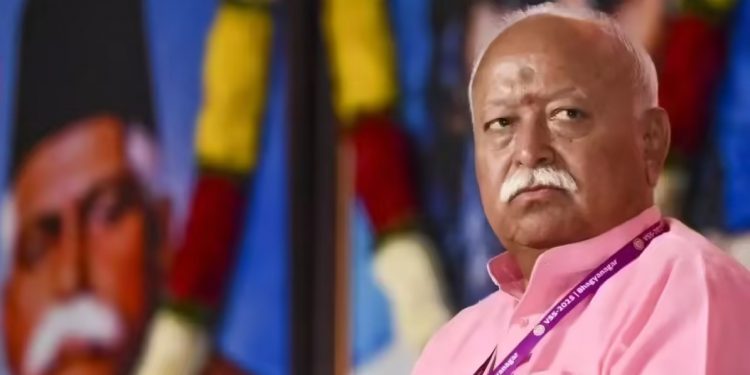
Rashtriya Swayamsevak Sangh chief Mohan Bhagwat has stated that despite wearing uniforms and conducting physical drills, the RSS is not a paramilitary organisation, and any such assumption would be incorrect. He also cautioned that attempting to understand the Sangh by associating it solely with the Bharatiya Janata Party would lead to serious misunderstanding.
read also: Rahul Gandhi Accuses RSS of Attempting to Influence India’s Institutions
Addressing a gathering of prominent citizens on Friday, Bhagwat said the RSS works to unite society and instil values and virtues to ensure that India never again comes under foreign domination. He explained that while the organisation conducts marches and traditional stick exercises, it remains a unique social body focused on character building rather than military structure.
Bhagwat emphasised that the Sangh should not be interpreted through the activities of the BJP or even through organisations like Vidya Bharti, stating that such comparisons fail to capture its true essence.
Although the RSS is widely regarded as the ideological parent of the Jana Sangh and its successor, the BJP, he maintained that the Sangh has its own independent purpose and functioning.

He also pointed out that a false narrative has been created around the RSS, largely due to superficial understanding and reliance on incomplete sources of information. According to him, many people do not explore original or credible references and instead depend on secondary platforms, which often present distorted views. Those who consult authentic sources, he said, can better understand the Sangh’s philosophy and work.
During the centenary year of the RSS, Bhagwat toured the country to address misconceptions and explain the organisation’s role.
He said the Sangh nurtures swayamsevaks by imparting values, discipline, and a collective vision aimed at achieving Bharat’s Param Vaibhav, or highest glory. He clarified that swayamsevaks are not controlled remotely, but are shaped through grassroots work carried out in local shakhas to create a patriotic and socially responsible environment.
Rejecting the notion that the RSS emerged as a reactionary force, Bhagwat said the organisation was neither formed in opposition to anyone nor does it compete with other entities. He added that the Sangh’s purpose is constructive and rooted in long term national development.
Reflecting on India’s history, Bhagwat observed that British rule was not the first instance of foreign invasion. He said that repeatedly, smaller groups from distant lands managed to defeat India despite lacking its wealth and cultural depth. This, he noted, raises important questions about internal weaknesses and the need for social unity to safeguard independence.
He stressed that while political freedom has been achieved, mental slavery still persists to some degree and must be overcome. He urged people to rise above selfish interests and foster unity based on shared values, asserting that a virtuous and cohesive society can positively transform the nation’s future.
The RSS chief also encouraged cultural self confidence, calling on people to take pride in their devotional traditions and indigenous food habits. Supporting the idea of Swadeshi, he said self reliance requires self pride, and citizens should prioritise goods produced within the country that generate employment locally. At the same time, he clarified that being Swadeshi does not mean cutting off trade with the world, but ensuring that imports are limited to essentials and conducted on India’s own terms, without external pressure.
Bhagwat stated that the financial position of the RSS is stable and that the organisation does not rely on external funding or donations. Recalling its past struggles, he said the Sangh faced opposition not only during British rule but also after Independence, including severe pressure, attacks, and even assassinations. He noted that such efforts to suppress the organisation still occur, though their intensity has reduced.
Concluding his address, Bhagwat invited people to visit an RSS shakha to gain firsthand understanding of the organisation. He said that true comprehension cannot come merely from explanations, comparing it to understanding the taste of sugar, which can only be known by experiencing it directly.


Discussion about this post