

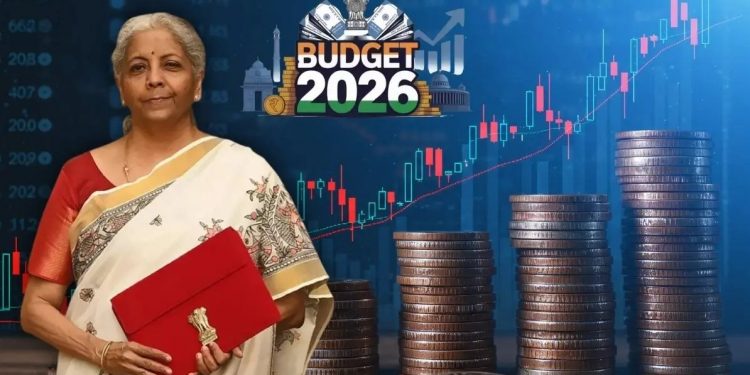
Finance Minister Nirmala Sitharaman is set to present the Union Budget for 2026–27 on February 1, marking her ninth consecutive Budget and the first time in independent India that the exercise will take place on a Sunday. The Budget comes at a time when India must navigate a fragile global economy marked by geopolitical tensions, fragmented trade, volatile financial markets and rising commodity prices.
So far, a mix of income tax relief, GST rationalisation, higher infrastructure spending and interest rate cuts by the Reserve Bank of India has helped cushion the economy against external shocks, including steep tariffs imposed by the United States on Indian goods. However, sustaining this momentum now presents a tougher challenge, especially as previous tax cuts have reduced the government’s revenue headroom.

The broader economic backdrop remains complex. While domestic demand has shown resilience and inflation has eased from recent peaks, uncertainty persists globally due to uneven monetary easing by major central banks, geopolitical risks and unpredictable commodity cycles. At home, the government faces mounting pressure to boost consumption, generate jobs and continue capital spending, all while keeping the fiscal deficit on a declining path.
Economists believe Sitharaman’s biggest task will be identifying a new growth driver at a time when investor sentiment has been shaken by concerns over India’s trade negotiations with the US. Continued foreign portfolio outflows, weakness in equities and a rupee at record lows have added to the urgency of restoring confidence.
There is speculation that the government could lean on petrol and diesel excise duties to shore up revenues, using the window created by earlier declines in global oil prices. Any such move is expected to be calibrated to avoid a direct burden on consumers. Alongside this, regulatory simplification and structural reforms aimed at attracting both domestic and foreign investment are likely to remain a focus.
Despite limited fiscal space, major spending cuts are not expected. Capital expenditure is set to remain the backbone of the Budget strategy, continuing the government’s push in areas such as roads, railways, defence manufacturing, urban infrastructure and logistics. For FY27, economists anticipate a further rise in capex, though at a slower pace than the post-pandemic surge, with priority sectors including renewable energy, power transmission, defence and urban transport. Support for state-level infrastructure through interest-free loans is also expected to continue.

On taxation, the emphasis is likely to be on stability rather than headline-grabbing giveaways. Any changes to personal income tax are expected to be incremental and targeted at supporting middle-class consumption. Corporate tax rates are expected to remain unchanged, with greater attention on compliance, digitisation and widening the tax base.
Employment generation is expected to feature prominently, with possible incentives for labour-intensive manufacturing, skilling and apprenticeships. Micro, small and medium enterprises, which have faced pressure from high input costs and tight credit, could receive enhanced support through higher allocations or expanded credit guarantees. Production-linked incentive schemes may also see refinements as the government reviews their effectiveness in boosting manufacturing, exports and jobs.
The green transition is another key theme, with likely measures to strengthen renewable energy, green hydrogen, battery storage and electric mobility. At the same time, allocations for oil and gas infrastructure and strategic reserves are expected to continue to safeguard energy security amid global volatility.
Although FY27 is not an election-year Budget, its political undertones will be closely watched ahead of key state polls. Balancing welfare spending with fiscal discipline will remain a delicate exercise, especially amid demands for higher rural support and targeted subsidies.
Overall, the Budget is expected to emphasise continuity over surprise, reinforcing long-term growth priorities while managing near-term economic risks. Markets will look for reassurance that India can sustain high growth without undermining macroeconomic stability.






Discussion about this post