

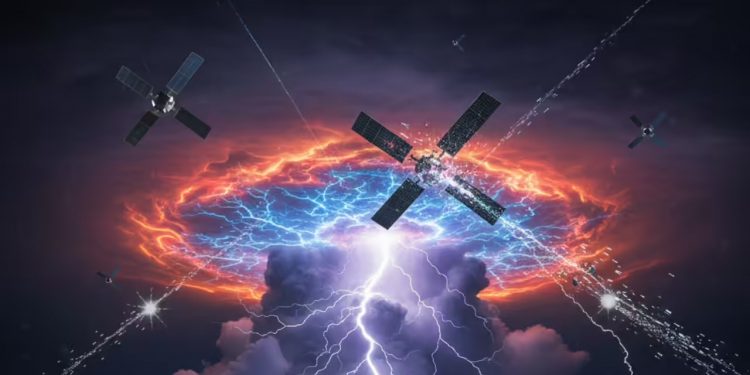
Lucknow | A new scientific study has revealed that GPS and navigation systems often malfunction during heavy rainstorms or lightning activity due to disturbances caused in the Earth’s upper atmosphere. Researchers found that lightning strikes interfere with signals used by GPS-based services such as Google Maps, leading to inaccurate directions during severe weather conditions.
According to scientists, lightning strikes and loud thunder create disturbances in the ionosphere, the upper layer of the Earth’s atmosphere. This layer plays a crucial role in transmitting GPS and radio signals from satellites to the ground. When lightning hits the ground, it triggers turbulence in the ionosphere, disrupting the smooth transmission of these signals.

The study highlights that India experiences some of the highest lightning incidents globally. As per a report by the Climate Resilient Observing Systems Promotion Council, more than 180 million lightning strikes are recorded in India every year. This makes the country particularly vulnerable to GPS-related disruptions, posing challenges for navigation systems that rely on satellite data.
Researchers from Lucknow University analysed data collected in 2024 from four Indian cities, including Bengaluru, Hyderabad, Kanpur, and Pune. The findings showed that lightning strikes create rapid fluctuations in the ionosphere’s Total Electron Content (TEC), which directly affects GPS signal accuracy.

The study further observed that within just 2 to 35 minutes of intense lightning activity, significant variations occur in ionospheric electron density. During this period, mobile phone GPS systems are most likely to provide incorrect location data, causing navigation errors for users.
Scientists concluded that understanding these atmospheric disturbances is essential for improving the reliability of GPS systems, especially in countries like India where lightning incidents are frequent.



Discussion about this post