

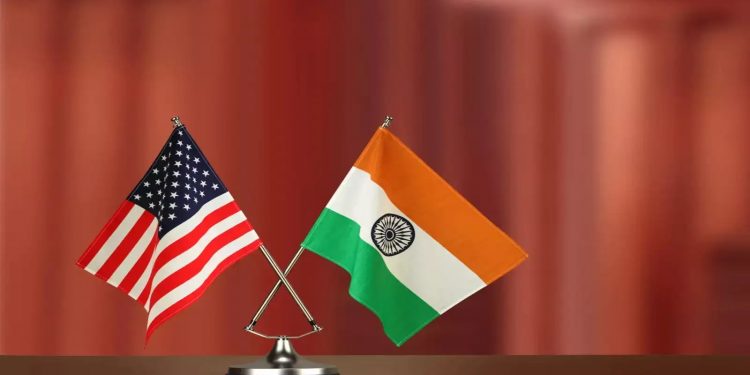
US Representative Ami Bera, speaking at a House Foreign Affairs Subcommittee hearing on South and Central Asia, underlined the long-standing bipartisan backing that the India–US partnership has consistently received from Congress and multiple White House administrations.
He stated that both nations share economic and strategic interests, adding that Washington and New Delhi aim to promote an environment of stability, prosperity and security that benefits citizens of both countries.
The hearing, titled ‘The US–India Strategic Partnership: Securing a Free and Open Indo-Pacific‘, included testimonies from Jeff Smith of the Heritage Foundation, Dhruva Jaishankar of the Observer Research Foundation America and Sameer Lalwani of the German Marshall Fund.

Bera expressed concern over the newly announced one-hundred-thousand-dollar H-1B visa fee, remarking that such measures weaken American businesses by limiting access to skilled talent. He also acknowledged that visuals of Prime Minister Narendra Modi meeting Russian President Vladimir Putin and Chinese President Xi Jinping have caused unease among some members of Congress.
Democratic Representative Pramila Jayapal criticised the tariffs imposed by the Trump administration, arguing that the policy harms India’s economy while simultaneously affecting American consumers and industries.
Commenting on the administration’s intensified immigration restrictions, Jayapal said that shutting down legal migration pathways undermines long-established people-to-people ties and echoes historical discriminatory quotas that once made Indian immigration extremely difficult. She noted that having personally come to the US on both a student visa and an H-1B visa, she recognises the damaging impact of these policies and remains committed to protecting legal avenues for immigrants from India and around the world.
Jayapal also raised concerns over rising anti-Indian hate in the United States, emphasising the crucial role Indian-Americans play in the US economy, from leading major corporations to driving innovation and scientific research.
Dhruva Jaishankar observed that the India–US partnership has expanded substantially since nineteen ninety-eight. From the period of strict US sanctions following India’s nuclear tests, the bilateral relationship has progressed significantly. However, he noted that current political hurdles have slowed further advancement.
He identified tariffs as the primary barrier, stating that President Trump’s push for balanced trade aligns with India’s own interests. He highlighted that India has signed several trade agreements in recent years and is actively negotiating more, suggesting that a resolution to tariff disagreements is within reach.
Jaishankar also pointed to renewed US engagement with Pakistan’s military leadership as another challenge. He stressed that Pakistan has a long record of using terrorist proxies against India, and that third-party mediation has historically encouraged further destabilising actions. He explained that the US policy of “de-hyphenation” — engaging with both India and Pakistan while staying out of bilateral disputes — has generally been effective and should continue.
He concluded by stating that significant opportunities for deeper India–US cooperation remain, provided that trade frictions and concerns regarding Pakistan are addressed constructively.
Discussion about this post