

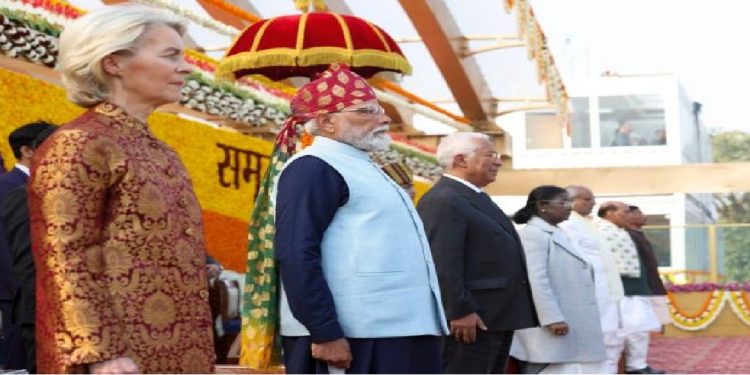
India celebrated its 77th Republic Day on Monday with a spectacular parade at Kartavya Path, showcasing the nation’s cultural richness, growing economic confidence, and formidable military capabilities. The event featured an impressive display of indigenously developed weapon systems, newly raised military units, and platforms that played a key role during Operation Sindoor.

President of the European Council Antonio Costa and President of the European Commission Ursula von der Leyen attended the celebrations as chief guests, highlighting a significant diplomatic engagement alongside the ceremonial and military grandeur.
The parade reflected India’s strategic autonomy, with defence platforms of both indigenous origin and diverse global sourcing, including Russian and American systems.

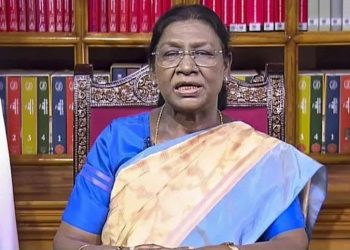
Although the central theme of this year’s celebrations was 150 years of ‘Vande Mataram’, Operation Sindoor featured prominently in the parade. President Droupadi Murmu took the salute after arriving at Kartavya Path in a traditional buggy, accompanied by the visiting dignitaries and the President’s Bodyguards. Prime Minister Narendra Modi, Defence Minister Rajnath Singh, senior ministers, top military leadership, diplomats, and officials were present at the ceremony.

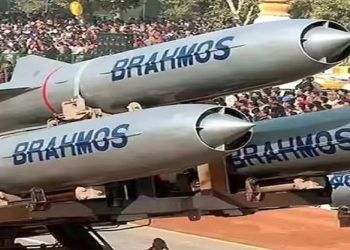
Prime Minister Modi later stated that the parade reflected India’s strong security framework, technological advancement, and unwavering resolve to protect its citizens. Among the major weapon systems on display were the BrahMos supersonic missile, Akash air defence system, Suryastra universal rocket launcher, Arjun main battle tank, Dhanush artillery guns, and the Divyastra battery.

Ahead of the parade, President Murmu conferred the Ashoka Chakra on Group Captain Shubhanshu Shukla, recognising his historic achievement as the first Indian to visit the International Space Station. The cultural segment of the parade opened with around 100 artistes performing on the theme ‘Vividata Mein Ekta’, presenting a vibrant musical display symbolising India’s unity in diversity.

The parade was commanded by Lieutenant General Bhavnish Kumar, General Officer Commanding Delhi Area. A tri-services tableau depicting Operation Sindoor attracted widespread attention, including a glass-encased integrated operations centre illustrating the use of BrahMos, Akash, and S-400 missile systems during the conflict in early May.

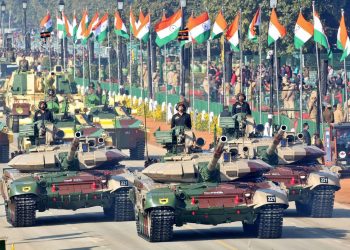
For the first time, the Indian Army presented a phased Battle Array Format, featuring reconnaissance units, mechanised columns, aerial components, and advanced combat support systems. Indigenous helicopters such as the Dhruv and Rudra, main battle tanks including T-90 Bhisma and Arjun, Apache and Prachand helicopters, infantry combat vehicles, unmanned ground vehicles, robotic systems, and new-generation unmanned weapon platforms were showcased.

The newly raised Bhairav battalion, designed as a specialised assault infantry unit, also made its debut appearance. The Indian Navy contingent and tableau highlighted the theme ‘Strong Navy for a Strong Nation’, depicting ancient maritime heritage alongside modern indigenous platforms like INS Vikrant and INS Udayagiri. The Air Force contingent marched in synchronisation with an aerial fly-past featuring Rafale, MiG-29, Su-30, and Jaguar aircraft in the symbolic ‘Sindoor Formation’.

The Defence Research and Development Organisation showcased the hypersonic glide missile LR-AShM, underlining India’s advances in cutting-edge defence technology. The parade concluded with an elaborate fly-past involving 29 aircraft and a thrilling motorcycle display by joint teams from the CRPF and SSB.
Around 10,000 special guests from across the country attended the celebrations. This year, the parade enclosures were named after major Indian rivers, symbolising the geographical and cultural flow that binds the nation together.





Discussion about this post