

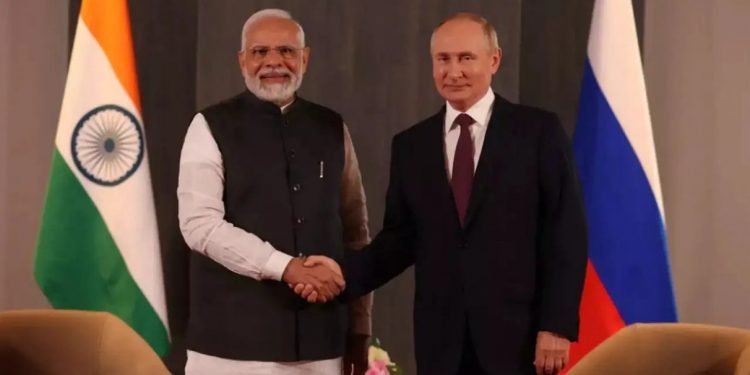
Russian President Vladimir Putin’s State visit to India is expected to place the long-standing trade imbalance at the forefront of bilateral discussions, as both governments consider lowering duties and easing non-tariff barriers to support a more even flow of goods.
During the two-day visit beginning Thursday, India and Russia are set to sign a landmark mobility agreement that will simplify the movement of skilled and semi-skilled Indian workers to Russia.
Officials from India’s Ministry of External Affairs described this pact as the most significant development, since the previous Annual Summit in 2024.
They noted that Russia’s demand for manpower has risen sharply, with the number of Indian workers increasing from around 10,000, a few years ago, to more than 100,000 now, alongside nearly 25000 Indian students in Russian institutions. New agreements are also expected in healthcare, academic research, cultural cooperation, and media exchange.
In a briefing from Moscow, Kremlin spokesperson Dmitry Peskov said, “Russia aims to build a framework that shields bilateral trade from external political pressure”.
He acknowledged that India’s purchases of Russian crude oil may face temporary disruption due to Western sanctions, yet insisted that Russia is taking steps to maintain steady supply channels. Addressing India’s concerns over the widening trade deficit, along with cooperation on small modular nuclear reactors and expanding defence and energy ties, is likely to feature prominently during the summit.

This visit is Putin’s first trip to India, since 2021 and his first since the start of the Russia-Ukraine conflict. It has been designated a rare State visit, unlike previous summits which were generally classified as working or official visits. The timing is significant as India faces additional US tariffs, including a punitive levy linked to its import of Russian crude.
Indian officials confirmed that both leaders will discuss defence cooperation and civil nuclear projects, though no major defence contracts are expected.
While India’s imports of Russian crude have recently slowed under the pressure of US tariffs, Russia has begun diversifying its purchases from India, including potatoes, pomegranates, and potentially more marine products. India, in return, aims to increase its annual fertiliser imports from Russia beyond the current 3 to 4 million metric tonnes.
India’s total imports from Russia are valued at around 65 billion dollars, largely dominated by crude oil, while Russian imports from India remain close to 5 billion dollars. A large business delegation accompanying Putin will explore opportunities in infrastructure, transport, energy, construction, agriculture, and fertilisers. Business leaders from both countries are scheduled to meet on Wednesday, indicating Russia’s readiness to reduce duties and non-tariff barriers.
Both sides are enthusiastic about finalising a free trade agreement between India and the Eurasian Economic Union, which could particularly benefit India’s pharmaceutical exports.
Peskov emphasised the need for a global trading system that does not rely on dollar-based payments as a political instrument, a point likely to emerge in the Modi-Putin talks. He also highlighted the success of joint defence projects, such as the BrahMos missile programme and indicated that the Russia-Ukraine conflict will inevitably shape part of the summit dialogue.
Indian officials expressed dissatisfaction with an editorial by 3 Western European envoys, who commented on India’s foreign policy choices, calling such interventions unacceptable.
Meanwhile, Russia’s State Duma has ratified the Reciprocal Exchange of Logistic Support agreement, a key military logistics pact that outlines procedures for the deployment of military units, warships, and aircraft between the two nations, and sets the framework for mutual logistical assistance. This ratification comes ahead of Putin’s arrival and is expected to reinforce defence coordination.

Discussion about this post