

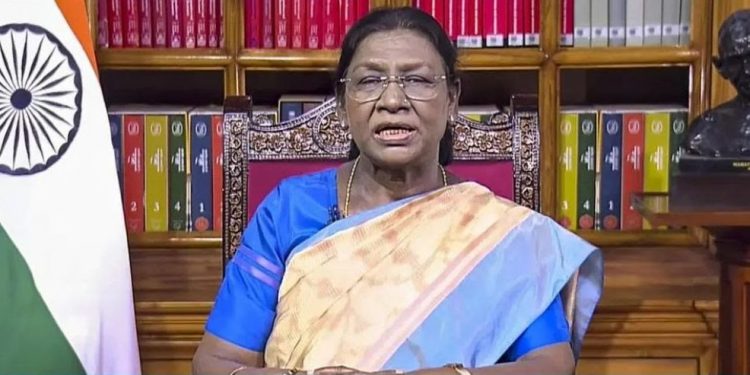
Amid escalating geopolitical tensions across several regions of the world, President Droupadi Murmu on Sunday said that India continues to spread the message of peace globally, a vision she described as essential for securing the future of humanity.
Addressing the nation on the eve of the 77th Republic Day, the President outlined India’s role as a messenger of peace while reaffirming the country’s deep civilisational commitment to universal harmony. She said that India’s traditions have always prayed for peace across the entire universe and stressed that humanity’s future can remain secure only when peace prevails worldwide.
“In an atmosphere marked by conflicts in many parts of the world, India is spreading the message of peace,” the President said, adding that India advocates harmony from a position of strength.

Underscoring the country’s firm commitment to national security, President Murmu highlighted the success of Operation Sindoor, a precision military operation that dismantled terror infrastructure across the border. She said terror centres were destroyed and several terrorists were neutralised, crediting India’s growing self-reliance in defence for the operation’s success.
Recalling her visits to the Siachen Base Camp, sorties in Sukhoi and Rafale fighter jets, and experience aboard the submarine INS Vaghsheer, the President said people have complete trust in the preparedness of the Army, Air Force and Navy. She noted that strong defence capabilities allow India to speak for peace with confidence.
President Murmu described the rise of nari shakti as a cornerstone of India’s journey towards becoming a developed nation by 2047. She said the active and empowered participation of women is vital for national development, noting that from rural self-help groups to space, defence and entrepreneurship, Indian women are shaping modern India.

She highlighted that over 10 crore women are associated with self-help groups, while nearly 46 percent of representatives in Panchayati Raj institutions are women. The Nari Shakti Vandan Adhiniyam, she said, will take women’s political empowerment to unprecedented levels and reinforce women-led development as a national priority.

Calling the past year a golden chapter for Indian women on the global stage, the President cited historic victories at the ICC Women’s Cricket World Cup and the Blind Women’s T20 World Cup. She also credited the Beti Bachao, Beti Padhao campaign with encouraging girls’ education across the country.
On social justice, President Murmu noted India’s major strides in poverty alleviation, stating that millions have risen above the poverty line. Emphasising the spirit of Antyodaya, she said the government remains focused on ensuring that beneficiaries do not fall back into poverty, with nearly 81 crore citizens receiving food security support through central schemes.

She stressed that the vision of a Viksit Bharat must be inclusive, with special focus on tribal and marginalised communities through targeted welfare interventions, giving concrete shape to Mahatma Gandhi’s ideal of Sarvodaya.
The President announced that the Constitution of India is now available in all 22 languages listed in the Eighth Schedule, a move aimed at promoting constitutional nationalism and allowing citizens to connect with the foundational document in their mother tongue.
Highlighting governance reforms, she said the government has adopted a citizen-centric approach by removing bureaucratic hurdles, repealing thousands of outdated rules and simplifying compliance norms. Public participation, she noted, has transformed government initiatives into mass movements.
President Murmu pointed to India’s global leadership in the digital economy, stating that more than half of the world’s digital transactions now take place in India. She said building a developed India is a shared responsibility, calling upon local institutions to drive grassroots change.

She also spoke of cultural decolonisation, saying the country is moving forward with renewed self-confidence rooted in its traditions and a Gyan Bharatam approach. Emphasising cultural self-reliance, she said renewed focus on Indian languages and indigenous knowledge systems is strengthening the foundation of national self-reliance.
The President hailed India as the world’s fastest-growing major economy and said structural reforms, including the Goods and Services Tax, have driven economic integration since Independence. Despite global uncertainty, she said India is firmly on track to become the world’s third-largest economy, guided by the principles of atmanirbharta and swadeshi.
Concluding her address, President Murmu highlighted the celebrations marking 150 years of Vande Mataram. She said the song transcended linguistic barriers during the freedom struggle and continues to symbolise India’s cultural unity across regions and languages.

Discussion about this post