

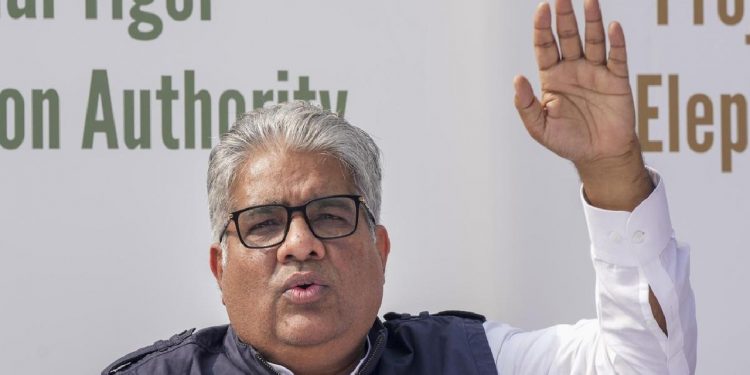
The central government has firmly rejected claims that the newly approved definition of the Aravalli range will open the door to widespread mining, asserting that more than 90 percent of the region will continue to remain under protection. Environment Minister Bhupender Yadav said the revised definition, cleared by the Supreme Court, strengthens conservation rather than diluting safeguards.

Speaking to the media after a meeting related to Project Elephant and the National Tiger Conservation Authority in the Sundarbans of West Bengal, Yadav said, no relaxation has been granted for mining activities in the Aravalli region. He alleged that misinformation was being circulated and urged critics to stop misleading the public.
According to the minister, the total geographical area of the Aravalli range spans about 1.44 lakh square kilometres, of which mining eligibility exists in only around 0.19 percent.
He said the remaining vast stretch of the mountain system is preserved and protected under existing environmental and judicial safeguards.
The Supreme Court, on November 20, 2025, accepted recommendations made by a committee constituted under the Ministry of Environment, Forests and Climate Change to establish a uniform definition of the Aravalli hills and ranges. Under this definition, an Aravalli hill is described as any landform in notified Aravalli districts that rises at least 100 metres above the local relief. An Aravalli range is defined as a cluster of two or more such hills located within a distance of 500 metres from each other.
The government clarified that it is incorrect to assume that areas below the 100 metre threshold are automatically open for mining. Officials explained that mining restrictions apply to entire hill systems, including enclosed landforms, and not merely to hilltops or slopes. The aim, they said, is to prevent exploitation near hill bases, which had occurred earlier due to vague and inconsistent definitions across states.
Sources in the Environment Ministry said the Supreme Court had set up the committee in May 2024 while hearing long-pending cases related to illegal mining in the Aravallis. The panel, chaired by the Environment Ministry Secretary and including representatives from Rajasthan, Haryana, Gujarat and Delhi along with technical institutions, found that only Rajasthan had followed a consistent definition since 2006. That definition treats landforms rising 100 metres or more above local relief as hills and bans mining within the lowest enclosing contour around them, regardless of internal elevations.

Yadav said confusion had been deliberately created around the 100 metre criterion. He explained that lower areas within hill systems remain protected and that land between two hills located within 500 metres is also treated as part of the range. He added that with this approach, more than 90 percent of the Aravalli landscape falls under protected status.
The minister said the government remains committed to conserving the Aravallis and highlighted initiatives such as the Green Aravalli movement aimed at restoring and preserving the fragile ecosystem. He alleged that false narratives were being pushed despite these efforts.
Officials said all four Aravalli states have agreed to adopt the Rajasthan definition with added safeguards to ensure transparency and objectivity. These include mandatory mapping of hills and ranges using Survey of India maps before granting any mining permission, treating closely located hills as a single range and clearly demarcating core and inviolate zones where mining is completely prohibited.

The government also said the Supreme Court has accepted the committee’s recommendation to ban mining in protected areas, eco sensitive zones, tiger reserves, wetlands and surrounding buffer areas. Limited exemptions may be considered only for critical and strategic minerals in national interest.
As per the court’s directions, no new mining leases will be issued in the Aravalli region until a comprehensive Management Plan for Sustainable Mining is prepared for the entire landscape by the Indian Council of Forestry Research and Education. Existing mines can continue operations only if they strictly follow sustainable mining norms prescribed by the committee.
District level assessments across Rajasthan, Haryana and Gujarat show that legally approved mining currently accounts for only about 0.19 percent of the total area across 37 Aravalli districts. Delhi, which includes five Aravalli districts, does not allow any mining at all.
The government said illegal and unregulated mining remains the biggest threat to the Aravalli ecosystem and the committee has recommended stricter enforcement measures, improved monitoring and greater use of technology such as drones and surveillance systems to curb violations.


Discussion about this post